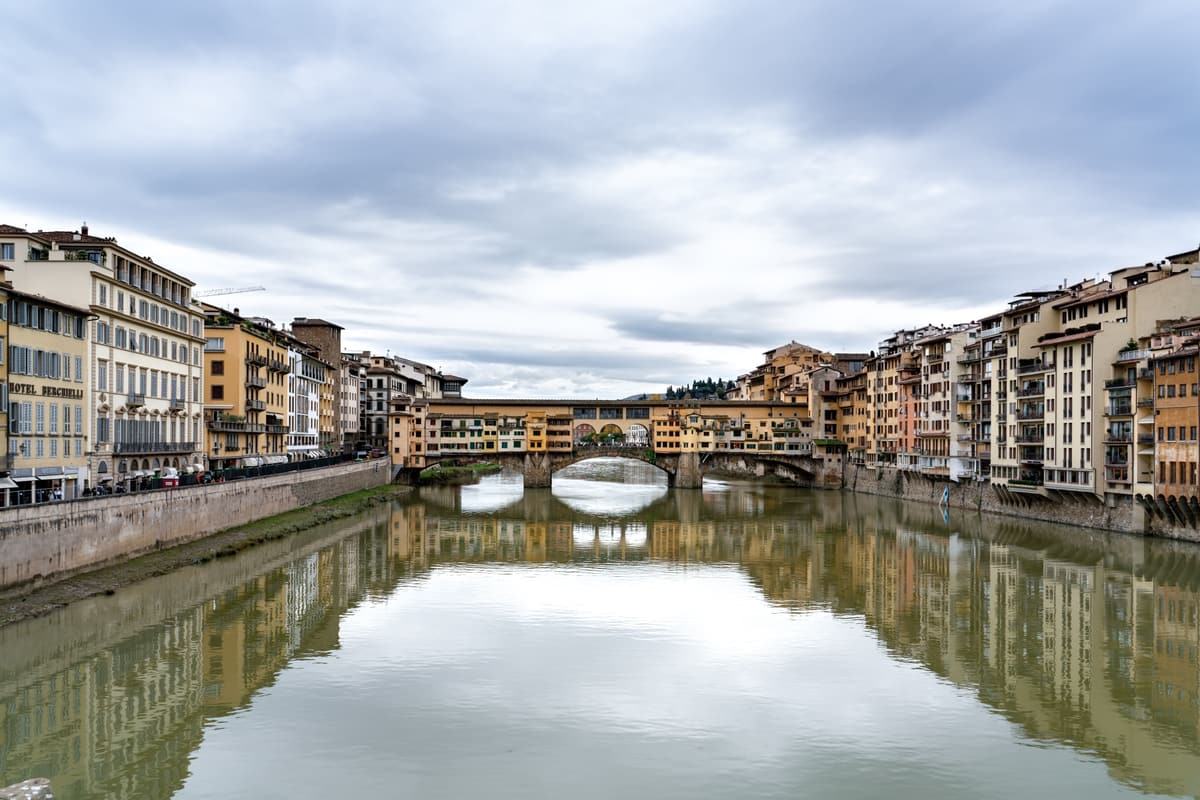
The Vasari Corridor — the Corridoio Vasariano — is an elevated, enclosed passage that threads from the Uffizi Galleries, along the Arno, over the top of the Ponte Vecchio and through to the Pitti Palace and Boboli Gardens on the far bank; the Uffizi describe it as about 750 metres long, though it is often cited as up to around a kilometre. It was designed by the painter and architect Giorgio Vasari and built at extraordinary speed in 1565 on the commission of Duke Cosimo I de' Medici, to mark the marriage of his son Francesco to Joanna of Austria. Its purpose was political as much as ceremonial: it let the Medici move privately and safely between the seat of government and their residence without ever setting foot in the public street.
For most of its modern life the Corridor was famous for the collection of artists' self-portraits that Cardinal Leopoldo de' Medici began hanging here in the 17th century — a collection that eventually grew to hundreds of works. Those self-portraits are no longer part of the route: they have been moved to dedicated rooms inside the main gallery. The reopened Corridor is instead presented as a walk through the structure itself, lined with almost three hundred ancient Greek and Latin marble inscriptions, around fifty Greco-Roman portrait busts of emperors and empresses, and 16th-century frescoes created under Vasari's own direction, with memorial spaces recalling the 1944 destruction of Florence's bridges and the 1993 Via dei Georgofili bombing that damaged this very passage.
The Corridor closed in 2016 and reopened to the public on 21 December 2024 after an eight-year restoration. It is reached only as part of a combined Uffizi + Vasari Corridor ticket, visited Tuesday to Sunday in tiny timed groups — a maximum of 25 people at a time, walking one direction from the Uffizi towards Boboli — and reservation is mandatory. Because the daily capacity is so small and the novelty so high, slots are released on a short horizon and disappear quickly.
The Corridor passes over the Ponte Vecchio, the medieval shop-lined bridge that is one of the most recognisable landmarks of Florence. The whole stage sits inside the Historic Centre of Florence, inscribed by UNESCO as a World Heritage Site in 1982 — the Corridor and the bridge are celebrated features within that listing rather than separately inscribed monuments. Tickets are nominative: each one is issued in a named visitor's name and is personal and non-transferable, with the name checked against a physical ID at the entrance. That is exactly why we collect each traveller's name up front and book in-name — so the ticket is valid for the person who walks through the door.